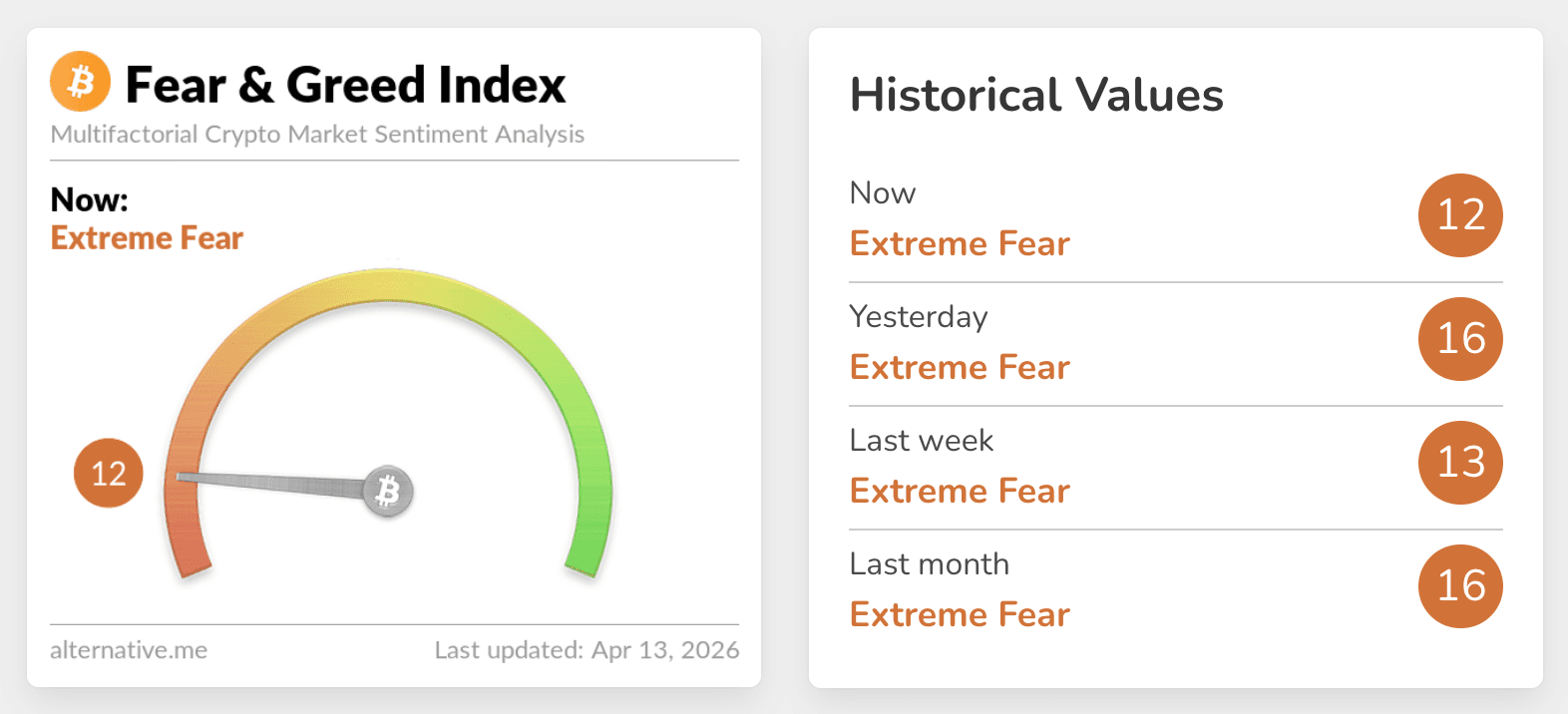
The crypto market is moving through one of those sessions where price action feels heavy even when nothing has fully broken yet. On April 13, 2026, traders are watching Bitcoin hold near the $70,000 zone, Ethereum struggle to regain momentum, and altcoins split into two very different groups: defensive survivors and speculative flyers. Total crypto market cap was reported around $2.49 trillion, with 24-hour volume near $80.86 billion, while Bitcoin dominance climbed to 56.8%—a classic sign that money is rotating toward relative safety inside crypto rather than spreading across the whole market. Sentiment also turned sharply cautious, with “Extreme Fear” readings returning as geopolitics, oil prices, and thin conviction combined into a nervous backdrop.
At the same time, live market pricing showed Bitcoin near $71,986.64, Ethereum around $2,214.68, and XRP near $1.34, confirming that the market is still active but far from confident. Bitcoin and Ether both pulled back after another failed attempt to push higher, and the broader tone remains risk-off rather than aggressively bullish.

Topic Explanation: What Is Happening in the Crypto Market Today?
The biggest story behind today’s market is not just crypto itself—it is the macro pressure sitting on top of it. According to market reporting, Bitcoin and Ether retreated as crude oil moved back above $100 per barrel after the U.S. blockade of the Strait of Hormuz intensified market anxiety. That matters because crypto is currently trading less like an isolated alternative system and more like a high-beta risk asset reacting to oil, the dollar, and geopolitical shocks. Bitcoin fell back toward the $70,600 area after failing to clear $74,000, while Ether slid from an April 11 high of $2,320 to around $2,190.
This weakness is also not brand new. Bitcoin has spent weeks trapped inside a broad range, with resistance repeatedly appearing between roughly $74,000 and $75,000 and support seen in the low-to-mid $60,000 area. That kind of repeated failure usually changes trader psychology. Instead of chasing upside, the market becomes reactive, short-term, and skeptical.
Another important detail is that the pressure above $70,000 is not just technical—it is behavioral. On-chain analytics cited by CoinDesk showed more than $20 million per hour in profit-taking whenever Bitcoin pushes into the $70,000–$80,000 band. In plain English, many holders are using strength to sell, which caps momentum and makes every rally feel fragile.
The derivatives market tells a similar story. Traders are leaning more toward downside protection than breakout optimism. Put options on Bitcoin are carrying a premium, altcoin futures positioning has turned more defensive, and market participation still looks cautious rather than conviction-driven.
Benefits / Details: Why This Market Setup Matters for Traders and Investors
A fearful market is uncomfortable, but it is also informative. When sentiment gets this weak, price behavior becomes clearer. The rise in Bitcoin dominance to 56.8% suggests investors are not leaving crypto entirely—they are moving toward the asset they trust most in uncertain conditions. That helps explain why many altcoins look weaker on a relative basis even when Bitcoin itself is only mildly down.
There is also a practical benefit in paying attention to low-volume, high-fear conditions: they often reveal where real demand actually lives. Reported 24-hour volume was about 23% below the 90-day average, which means both bulls and bears are trading with less conviction than usual. Markets like this can stay dull for a while, but when they finally break, the move is often sharper because liquidity is thinner.
For long-term investors, this kind of session offers something else—context. There is no major protocol collapse, no stablecoin failure, and no obvious systemwide breakdown in infrastructure. Instead, the market is being squeezed by macro fear, profit-taking, and hesitation. That distinction matters because panic driven by external headlines is different from panic caused by structural failure inside crypto itself.
Today’s market also shows why headline watching alone is not enough. While majors are stuck, pockets of the market are still moving. Some DeFi and memecoin names have outperformed, and a few Layer-1 assets have shown relative resilience. That tells us capital is rotating, not disappearing. For active traders, that can create short-term opportunities. For cautious investors, it is a reminder to separate broad market weakness from selective strength.
One more detail worth noting is institutional signal. Strategy added 13,927 Bitcoin for roughly $1 billion at an average price near $71,902, lifting its holdings to 780,897 BTC. Even in a shaky tape, that kind of corporate accumulation reinforces the idea that big buyers still view weakness as an opportunity rather than a reason to abandon the asset class.
Examples: Real Market Moves From Bitcoin, Ethereum, and Altcoins
Bitcoin is the clearest example of today’s tension. It is not crashing, but it is also not escaping. Spot pricing near $71,986.64 looks stable on the surface, yet the market keeps rejecting breakouts above the low-to-mid $70,000s. That makes the $70,000 area feel less like a launchpad and more like a stress test.
Ethereum offers a second example. ETH remained above $2,200 in live pricing, but earlier reporting showed it sliding from roughly $2,320 to about $2,190 as macro pressure intensified. That is not catastrophic, yet it underlines the same problem: even when the market bounces, follow-through is weak.
Among altcoins, the picture is more divided. CoinDesk reported strength in names like AAVE, HYPE, and JUP, while memecoins such as BROCCOLI and BAN posted outsized gains even as the wider market stayed flat. That kind of behavior is common in uncertain markets: speculative capital does not vanish, it just becomes narrower and more opportunistic.
A separate market snapshot also highlighted relative resilience in BNB and TRON, while Solana lost less than Bitcoin on the day. These are not yet full trend reversals, but they matter because they show that traders are still willing to reward tokens with exchange utility, network demand, or stronger relative flows.
FAQs
Is the crypto market bearish on April 13, 2026?
It is cautious more than outright broken. Sentiment is clearly weak, with “Extreme Fear” in circulation, but price action still looks more like stressed consolidation than full capitulation. Bitcoin remains above key psychological support near $70,000, and the broader market has not shown signs of systemic collapse.
Why is Bitcoin struggling near $70K?
Because the market keeps meeting heavy selling every time price pushes higher. CoinDesk cited profit realization above $20 million per hour in the $70,000–$80,000 band, which means rallies are being used as exit points by existing holders.
Why are oil prices affecting crypto?
The current crypto market is reacting strongly to macro and geopolitical news. Oil moving above $100 after the Strait of Hormuz blockade reinforced inflation and risk concerns, and that pushed traders toward defensive positioning across crypto.
Are altcoins dead right now?
No, but broad altcoin strength is still missing. What we are seeing instead is selective rotation. Some DeFi tokens, memecoins, and a few Layer-1 assets are outperforming, while much of the rest of the altcoin market remains soft.
Is this a buying opportunity?
That depends on strategy and risk tolerance. Fear-driven markets can create attractive entries, and historical commentary in today’s market snapshot noted that very low fear readings have often preceded stronger 30-day returns. Still, timing remains difficult, especially with macro risk and resistance overhead.
Conclusion
April 13, 2026 is shaping up as a classic “wait, watch, and respect the tape” kind of day for crypto. Bitcoin is still the center of gravity, holding near $70,000 while the rest of the market struggles to find confidence. Ethereum remains soft, altcoins are mixed, and geopolitical pressure is keeping traders defensive. Yet under the surface, the market is not dead—it is rotating, filtering, and testing conviction. That usually means the next real move will matter more than today’s noise.

Leave a Reply